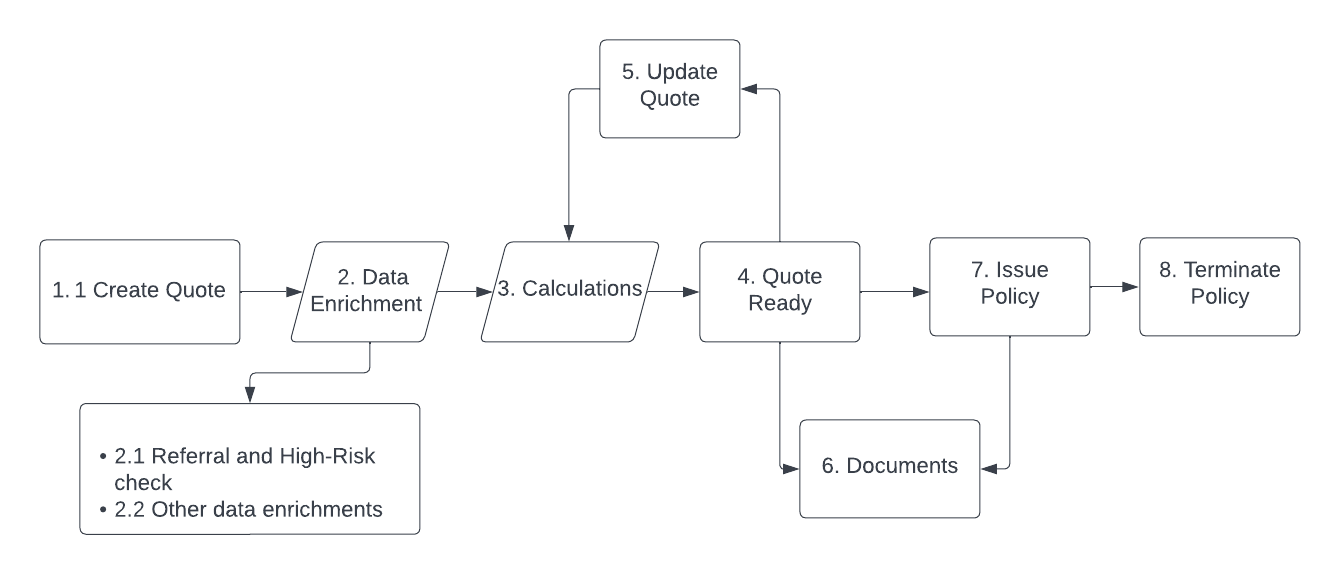
This section outlines the recommended API requests sequence to be used when making requests. It covers the full policy lifecycle from authentication, quote creation, data enrichment, calculation, validation, policy issuance, to termination and MTAs (Mid-Term Adjustments).
User logs in to receive a bearer token used in all subsequent requests.
Purpose: Retrieve bearer token for further authorization.
Initializes a quote using customer and insured item data.
Purpose: Create a new insurance quote.
Returns total period premium based on input data.
Purpose: Fetch calculated premiums.
Returns available next actions or processing status.
Purpose: Confirm that quote processes are complete.
Returns all data including customer, products, and pricing.
Purpose: Retrieve complete quote information.
Enables updates to customer, insured item, and policy parameters.
Purpose: Modify data in the quote.
Recalculates quote after updates with the latest input.
Purpose: Re-run premium calculations.
Generates the main document and additional quote files.
Purpose: Create PDF documents for the quote.
Binds the quote to preserve conditions until issuing.
Purpose: Lock the quote terms and premiums.
Triggers the issuance process and returns a tracking request ID.
Purpose: Issue the policy from a bound quote.
Checks whether the policy is successfully issued or still pending.
Purpose: Poll for the policy issuing status.
Returns latest policy version including all fields and documents.
Purpose: Fetch the full policy details.
Terminates the policy with provided reason and termination type.
Purpose: End an active policy.
Starts an MTA process and creates a new quote based on the current policy.
Purpose: Initiate changes to an existing policy.
Involves readiness check, update, recalculation, binding, and issuing.
Purpose: Proceed with the same steps as issuing a new quote.
- All steps require authentication with a valid bearer token.
- Mandatory headers must include
x-tenant-idandContent-Type: application/json; charset=UTF-8. - Quote must be ready before update, bind, or issue actions can proceed.
For a better understanding of the sequence of API calls required for generating and managing policies, refer to the flow diagram and sequence diagram below: